
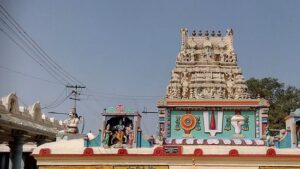
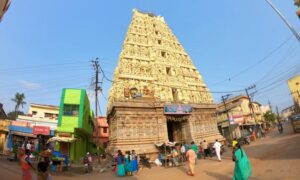
 Some places are not just buildings. They become memory, identity, and emotion all at once. Sri Talpagiri Ranganathaswamy Temple in Nellore is one of those places. Andhra Pradesh’s tourism portal describes it as a major sacred site in Nellore, notes that it stands beside the Pennar, and highlights its towering gopuram and reclining form of Lord Vishnu. The official district page also describes it as one of Nellore’s oldest temples, connecting its narrative to the city’s ancient history. What makes this temple special is not only age or religious importance. It is the way it lives in Nellore’s daily imagination. The district website says that when people enter the city after crossing the Penna, one of the first structures that catches the eye is the temple tower. That image says everything. This is not a shrine hidden in a corner. It is a public symbol, almost like a spiritual skyline marker. It reminds people that urban life may race ahead, but some places quietly continue to hold the soul of a town together.
Where the Temple Is Located and Why the Setting Matters
The temple stands in Ranganayakulapeta, Nellore, on the banks of the Penna River, also called Pinakini in older references. That riverside location is not a decorative detail. It shapes the entire mood of the shrine. Official Nellore district information identifies the Penna as the principal river of the district, while the district temple page repeatedly connects the temple’s spiritual character to the river flowing by its side. The Incredible India page for Nellore also places the temple beside the Pennar and describes it as one of the key sacred attractions in the region.
Why does this connection matter so much? Temples often evoke experiences through their setting, as much as through their sculpture or ritual. A shrine beside a river has a different energy from one in the middle of a bazaar. Here, the landscape adds softness to the architecture.
That idea is beautiful when you contemplate it. Pilgrimage would not have been just a walk through streets. It may have felt like an arrival from water to stone, from movement to stillness.
The History of Ranganathaswamy Temple Nellore
History at old South Indian temples is often layered rather than linear, and this temple is a perfect example. The official district temple page says the shrine dates back to the 7th–8th centuries CE, linking its origin to the Pallava period, while additions to the main shrine and further extensions are associated with the Cholas in the 12th century. The same source adds that the grand Raja Gopuram came later, in the 1800s. Andhra Pradesh tourism, meanwhile, describes the temple as over 600 years old, which suggests that different official and tourism narratives emphasize different parts of the temple’s long life. The safest way to understand it is as follows: the shrine is ancient, it likely has early medieval roots, and it expanded in multiple phases over centuries. That layered development actually makes the temple more interesting. Many people look for a single neat founding date, but sacred places rarely work that way. A temple can begin as an early shrine, gain structural additions under one dynasty, receive artistic or ritual patronage under another, and then become visually redefined by a later tower or mandapam. The district page even mentions Nellore’s identity as Vikramasimhapuri in the 11th and 12th centuries and presents the temple as a link between ancient Nellore and the present city. In other words, the shrine is not just old; it is a surviving timeline. You are not seeing one century when you stand there. You are seeing many centuries stacked like layers of lamp soot, stone, prayer, and memory
The Raja Gopuram and the Temple’s Visual Identity
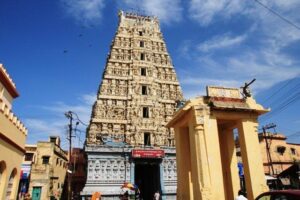
Every famous temple has one feature that becomes its visual signature. For Sri Talpagiri Ranganathaswamy Temple, that feature is the Raja Gopuram, often described locally as the Gali Gopuram. The Nellore district temple page says the eastern Raja Gopuram was constructed in 1849 by Sri Yeragudipati Venkatachalam Panthulu, while the same page elsewhere describes the tower as close to 100 feet high. Andhra Pradesh tourism also calls attention to its towering gopuram, and other travel summaries echo that vertical prominence, though official government sources are the strongest basis here.
A gopuram does more than announce entrance. It creates emotional scale. Even before a visitor understands the temple’s mythology or ritual system, the tower communicates grandeur. It says: pause, look up, reduce your speed. That is why such towers often become city landmarks. In Nellore, this one clearly has. The district page vividly notes that the tower is one of the first things visible upon entering the city and one of the last visible while leaving by train. That kind of description is almost poetic, but it also reveals something urban and practical. The temple tower has become part of the way the city is seen, navigated, and remembered. Some landmarks are famous because guidebooks say so. This one is famous because residents physically live with it in their line of sight.
Meaning of “Talpagiri” and the Legend Behind the Temple
Temple names in India are rarely random labels. They are compact stories. According to the official Nellore district temple page, the name Talpagiri comes from a legend in which Adi Sesha, the divine serpent associated with Lord Vishnu, took the form of a hill or resting place when Vishnu descended to earth and reclined here. The page explains that “Talpa” refers to the couch of the serpent on which Vishnu rests. That legend gives the temple not just a geographical presence but a cosmic one. The land itself becomes sacred furniture, so to speak, a divine resting place shaped by myth.
This is one reason the temple’s story stays with people. It offers an image that is easy to remember and hard to forget. Vishnu is not only worshipped here; he is imagined as resting here, held by Adi Sesha, with the landscape itself participating in the act of devotion. There is something deeply human about that image. We all understand the need for rest, shelter, and refuge. A reclining deity softens the emotional distance between god and devotee. Instead of only power, the icon carries calm. Instead of only awe, it offers reassurance. That may be why Ranganatha temples feel so different from shrines centered on fierce or martial forms of divinity. They feel like places where eternity breathes slowly. And Talpagiri, by name and legend, turns that feeling into geography.
The Main Deity: Reclining Lord Ranganatha in a Rare Form
The main deity here is Lord Ranganatha, a reclining form of Lord Vishnu. The Incredible India page for Nellore notes that the temple houses a rare 10-foot-long reclining idol of Lord Ranganatha on Adisesha, with Goddess Sridevi on his chest and 26-inch-high idols of Sridevi and Bhudevi at his feet. The district temple page also identifies the deity locally as Ranganayakulu or Pallikonda Perumal, emphasizing the reclining form.
What is especially striking is that this is not presented as just another Ranganatha idol. The district page says the deity reclines in an opposite direction compared with many other Ranganathaswamy temples and links this to the temple’s west-facing layout. That matters because difference creates memory.
Here, the reclining Lord is both familiar and distinct. He belongs to a long Vaishnava tradition, yet the temple gives that tradition a local accent. Think of it like a classical raga sung in a unique voice. The composition remains ancient, but the rendition becomes unmistakably Nellore.
A West-Facing Temple That Breaks the Usual Pattern
Most major Hindu temples are east-facing, so the fact that this temple’s main deity faces west toward the Penna River is one of its most discussed features. The Nellore district temple page clearly states that this west-facing orientation is unusual and points out that when visitors enter from the east through the Raja Gopuram, they first encounter the wall of the garbha griha rather than a direct frontal view of the sanctum. The same source suggests that the orientation may relate either to the temple’s sacred geography or to older architectural logic linked to the original river approach.
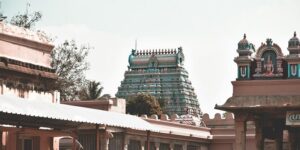
That west-facing arrangement does something fascinating to the visitor experience. It interrupts habit. You cannot move through the temple on autopilot. Your body has to adjust, your expectation has to bend, and suddenly the place feels more mysterious. Architecture here is not just construction; it is choreography. The district page even mentions a local childhood story that the deity turned away from the city because of the adharma of Kali Yuga, though it frames this as folklore rather than historical fact. Whether one treats that as legend or affectionate local imagination, it shows how architecture invites story. When a temple departs from standard direction, people do not leave the gap empty. They fill it with meaning. That is precisely how sacred spaces stay alive across generations.
Other Shrines and Sacred Spaces Inside the Complex
A good temple complex is never only about one sanctum. It is a sacred ecosystem. The district temple page notes that beyond the main shrine, the complex includes shrines for Goddess Ranganayaki, an Alwar Sannidhi for the 12 Alwars, and shrines for Lord Narasimha and Lord Venkateshwara. This matters because it places the temple within a broader Sri Vaishnava devotional world, where the divine is encountered through multiple forms, saints, and theological relationships rather than a single isolated icon.
For a visitor, these side shrines change the rhythm of darshan. You do not simply arrive, bow once, and leave. You move. You circle. You pause at related presences. That is how temple space teaches theology without a textbook. The consort shrine reminds you that divine energy is relational. The Alwars connect the temple to centuries of Tamil and South Indian bhakti poetry. Narasimha adds a more intense Vishnu form to balance the serenity of Ranganatha. Venkateshwara bridges local devotion with one of the most beloved Vaishnava traditions in the region. It is a bit like entering a family home rather than a formal office. The main deity remains central, but the surrounding presences make the experience warmer, fuller, and more emotionally textured.
Festivals That Turn Devotion Into Public Celebration
If you really want to understand a temple, do not study it only on a quiet weekday. See what happens during festival time. In 2026, Deccan Chronicle reported that the annual Brahmotsavams at the temple began on February 26 and continued until March 8, with rituals conducted according to Pancharatra Agama. The report lists daily special poojas, vahana sevas, and cultural events, and identifies major highlights including Hanumantha Seva, Golden Garuda Seva, Kalyanotsavam, Rathotsavam, and Teppotsavam. A separate March 2026 report says thousands gathered for the Rathotsavam, pulling the chariot through localities in Nellore amid chanting and public participation.
This is where the temple stops being only a sacred structure and becomes a civic heartbeat. Festivals pull worship out of enclosed stone and into the streets. The deity moves, the crowd responds, the city gathers, and devotion becomes visible. One recent report even called the temple the “Sri Rangam of the North,” a phrase that captures how strongly the shrine is valued in regional religious culture.
During Brahmotsavam, this symbolic status becomes tangible. Lights, processions, music, flowers, silk offerings, and chariot rituals do not merely decorate tradition. They renew it in public, year after year, so that even younger generations experience faith not as an inheritance locked in the past but as something happening now.
Quick Facts for a Travel Blog Reader
Here is a simple snapshot of the temple for readers planning a visit or writing about Nellore tourism:
| Feature | Details |
|---|---|
| Temple name | Sri Talpagiri Ranganathaswamy Temple |
| Location | Ranganayakulapeta, Nellore, on the banks of the Penna/Pennar River |
| Main deity | Lord Ranganatha, reclining form of Vishnu |
| Notable icon | Rare 10-foot reclining idol on Adisesha |
| Special architectural feature | West-facing sanctum and iconic Raja/Gali Gopuram |
| Historical layers | Early roots linked to Pallavas, later Chola additions, Raja Gopuram in 1849 |
| Major annual festival | Brahmotsavams with Rathotsavam and Teppotsavam |
| Best season to visit Nellore | October to March |
These facts come from the official district page, Andhra Pradesh tourism information, and recent reporting on the temple’s 2026 festival calendar. For a blogger, that combination is helpful because it gives both timeless context and current relevance. Many heritage posts fail because they swing too far in one direction: either all myth and no practical detail, or all logistics and no feeling. This temple deserves both. It is an ancient shrine with active ritual life, a local landmark with regional pull, and a place where religious tradition still spills naturally into the public streets. That balance is exactly what makes it a strong subject for a travel or culture blog.
Best Time to Visit and How to Reach
According to the Incredible India page for Nellore, the best time to visit is October to March, when the weather is more pleasant. The same page notes that Nellore Railway Station (NLR) is the nearest railhead, Tirupati Airport is about 120 km away, and Chennai International Airport is roughly 185–190 km away. It also says the destination is well connected by road from nearby cities and towns.
For blog readers, the smartest advice is simple. If you want a peaceful darshan and good photographs of the exterior, visit in the cooler months and go early in the morning or toward evening. If you want to feel the temple at full emotional volume, aim for the annual Brahmotsavam period, keeping in mind that crowds will be much larger. There is no single “right” way to experience a sacred place. Quiet days reveal stone, space, and atmosphere. Festival days reveal community, sound, and movement. One is like reading a great poem alone. The other is like hearing it sung by an entire town. Either way, Ranganathaswamy Temple in Nellore offers more than a checklist stop. It offers a mood, a memory, and a living connection between river, ritual, and city.
Conclusion
Sri Talpagiri Ranganathaswamy Temple, Nellore is not just a historic shrine dedicated to Lord Vishnu. It is a place where myth, architecture, local identity, and living devotion meet in a remarkably natural way. Its riverside location on the Penna, its west-facing sanctum, its reclining Lord Ranganatha, and its striking Raja Gopuram give it a personality that stands apart from many other temples.
It is visually memorable, spiritually important, and rooted in stories that people still tell. Some landmarks impress you for a moment and fade. This one lingers. Maybe that is because the image at its center is not of a warrior rushing forward but of a divine presence resting in stillness beside a river. In a noisy world, that kind of sacred calm has unusual power. And in Nellore, it has a name that the city continues to say with affection and pride: Ranganathaswamy Temple.
FAQs
1. What is the other name of Ranganathaswamy Temple in Nellore?
The temple is also widely known as Sri Talpagiri Ranganathaswamy Temple and is associated with Ranganayakulapeta in Nellore. Official district information also refers to the deity locally as Ranganayakulu.
2. Why is the temple called Talpagiri?
The official district temple page links the name to the legend of Adi Sesha, explaining that “Talpa” refers to the serpent couch on which Lord Vishnu reclines.
3. What is unique about the idol in this temple?
The temple houses a rare 10-foot-long reclining idol of Lord Ranganatha on Adisesha, with associated images of Sridevi and Bhudevi, according to Incredible India’s Nellore tourism page.
4. Which festival is most important at the temple?
The annual Brahmotsavams are the major celebration, and recent reporting highlights key events such as Golden Garuda Seva, Kalyanotsavam, Rathotsavam, and Teppotsavam.
5. When is the best time to visit Ranganathaswamy Temple Nellore?
For general travel comfort, the Nellore tourism page recommends October to March as the best time to visit the city and its major attractions, including this temple.
very good